When should an agency hire a video editor?
A practical guide for agencies deciding between occasional freelance help and recurring post-production capacity.
Hiring a video editor looks like a capacity decision, but for agencies it is usually a delivery decision. Volume, review time, client context, motion support, and backup determine which setup works.
In short
- A freelancer is often enough for well-defined projects with limited handover.
- Recurring capacity becomes more useful when several clients, styles, and deadlines overlap.
- The main operational risk sits in briefing, review, context loss, and dependence on one person.
- FutureFlows fits agencies that want to outsource post-production while retaining client and creative direction.
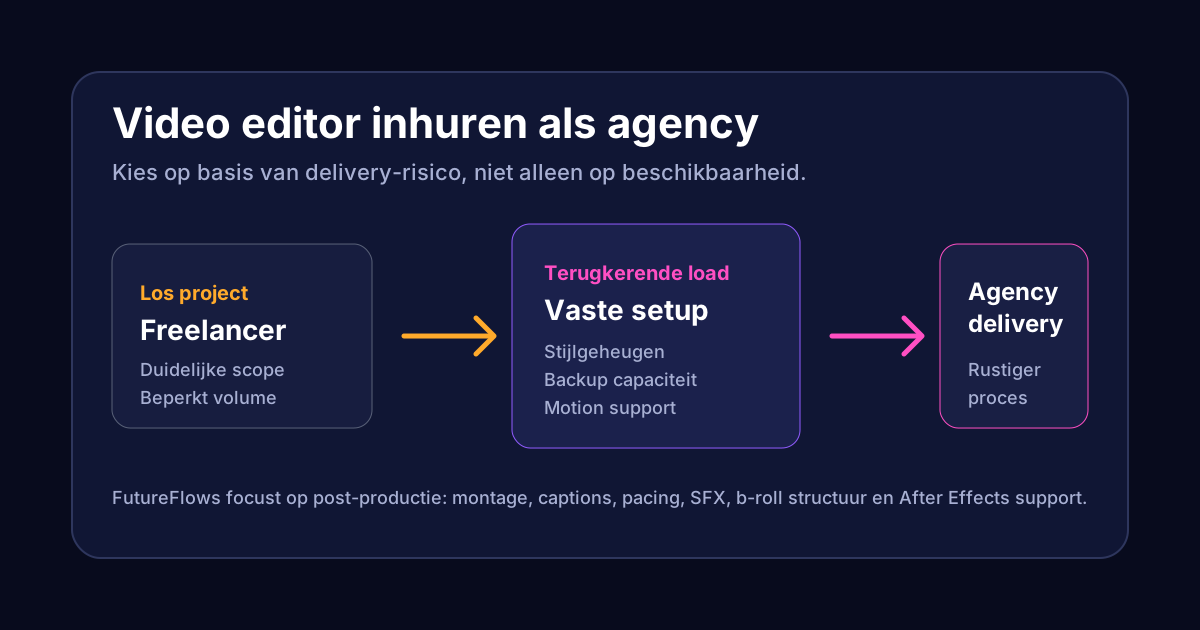
The question is bigger than who can edit this
Agencies often start looking for an editor when the calendar is already full. A campaign needs variants, a shoot needs to become a month of social content, or the internal editor has several deadlines in the same week. The immediate question is who can take the work.
For recurring client work, editing skill is only one part of the answer. Someone also needs to understand the brief, the client style, previous feedback, platform requirements, and where motion adds value. That context determines how much management remains with the agency.
A useful hiring decision therefore starts with delivery risk: how often does the work return, how much context has to be repeated, what happens when the editor is unavailable, and how much internal review is still required?
When a freelance editor is a good choice
A freelancer can be exactly right for a defined project with clear input, a recognisable style, and few dependencies. A case study with prepared selects or a short social cut with strong references does not necessarily need a larger production setup.
This works best when the agency can still own project management and quality control. The freelancer executes a clear scope while the agency controls the brief, feedback, timing, and final approval.
- The assignment is one-off or only occasionally recurring.
- The desired style can be transferred through clear examples.
- The work requires little additional motion or compositing.
- Your team has time to manage feedback and quality control.
- Long-term availability is not critical to the delivery plan.
Where agency editing setups usually break
The first edit is rarely the problem. The brief is fresh and everyone is willing to explain decisions. Friction appears after several rounds, when preferences live in messages and a new editor has to reconstruct why earlier choices were made.
Different clients may need different caption rhythms, pacing, safe zones, and export logic. If this context only exists in an account manager's head, outsourcing still leaves the agency acting as translator, quality controller, and backup planner.
That hidden coordination time matters as much as editing hours. A setup that produces usable files but consumes constant internal attention will not scale well.
Capacity is not the same as continuity
Capacity means someone has time to take a task. Continuity means the work still runs consistently next month without rebuilding the brief from zero. One-off projects mainly need capacity; recurring agency work benefits from continuity.
An editor who remembers client preferences and previous feedback can start closer to the expected direction. Review becomes more specific and less repetitive, particularly when one agency manages several brands at the same time.
Continuity also includes backup. Holidays, illness, or a full calendar should not surprise an agency whose client retainers depend on regular delivery.
When recurring editing capacity makes sense
Recurring capacity becomes relevant when the workload feels like a stream rather than separate tasks. Briefs, assets, review rounds, and exports need a repeatable rhythm, while each client still retains its own style.
This is often where an occasional editor helps but does not remove the pressure. More formats appear, paid teams request new hooks, and motion becomes part of edits that previously needed only cuts. The question changes from whether the team can make the video to whether it can deliver reliably every month.
- Client content returns weekly or monthly.
- Several clients have different styles and review preferences.
- Captions, sound, b-roll structure, or motion support recur.
- Your team spends too much time explaining and checking work.
- The current setup becomes fragile when one editor is unavailable.
What to define before hiring
Write down the actual work before asking for a video editor. Reviewing hours of raw footage is different from editing prepared selects. A captioned Reel is different from an ad with several hooks, motion overlays, and platform variants.
Clarify who selects footage, owns the hook, checks captions, protects brand guidelines, gathers feedback, and prepares each format. This prevents a small assignment from quietly becoming an undefined post-production role.
- 1.How many deliverables return each month?
- 2.Will the editor receive raw footage or prepared selects?
- 3.Are captions, sound, color, b-roll, and motion included?
- 4.How many platform formats are needed per video?
- 5.Who gathers client feedback and turns it into edit notes?
- 6.Which previous edits and brand assets should guide the work?
- 7.How are urgent or out-of-scope requests handled?
Evaluate the workflow, not only the showreel
A trial project should show how collaboration works. Does the editor ask useful questions, flag missing assets, process feedback accurately, and prepare clean exports? A polished showreel cannot answer those operational questions.
Use real assets, real preferences, and a realistic deadline. Then measure how much internal energy the project still needs. Good support does not eliminate feedback, but it makes each round clearer and more focused.
Where FutureFlows fits
FutureFlows supports agencies when post-production becomes a recurring bottleneck. The focus is editing, captions, pacing, sound, b-roll structure, motion support, and delivery continuity around supplied material.
The agency retains the client relationship and creative direction. FutureFlows works as an editing arm behind the scenes, building useful context over time and providing a clearer structure for recurring delivery.
If you need one isolated video, start light. If client work, styles, motion needs, and backup recur, evaluate a continuing post-production setup.
Next step
Want to see whether recurring editing capacity fits your agency? Explore how FutureFlows can support client work, motion design, and backup behind the scenes.
Explore editing capacity for agencies